Tag Archives: E-Cig Components

VAPESKY Clean Room Miracle: 500 E-Cigs/Second Assembly Line

HF005-intro-1

Speed and precision define e-cig manufacturing success. Importantly, VAPESKY has redefined both with its state-of-the-art clean room assembly line. Producing 500 e-cigarettes per second once seemed impossible; yet, now it’s daily reality at our facilities. We rely on cutting-edge automation, strict clean room rules, and uncompromising quality focus. Indeed, this isn’t just a production milestone—it’s proof that engineering excellence and compliance can scale together.

1. The Engineering of VAPESKY’s Clean Room

VAPESKY’s 500-unit-per-second production centers on our ISO 8 certified clean room. We designed this space primarily to eliminate contamination; additionally, it ensures compliance with global regulatory standards. Unlike conventional factories, we maintain particle counts below 352,000 (≥0.5μm) per cubic meter—this far exceeds industry baselines. Such hygiene is critical for e-cig safety, because tiny impurities can ruin e-liquid quality or heating coil performance.

All equipment and staff follow VAPESKY’s ISO 8 clean room certification protocols. Specifically, we use HEPA air filtration systems, and all staff wear mandatory sterile gowns. Furthermore, we optimized the clean room for workflow efficiency: modular production stations follow a linear flow, which minimizes material movement and reduces bottlenecks. We also transport components via sealed conveyor belts, so no external exposure occurs before assembly.
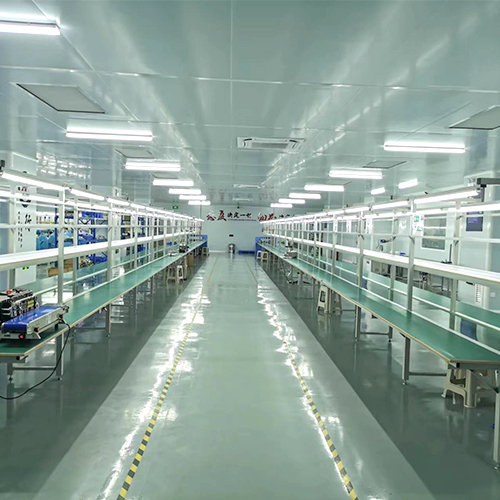
VAPESKY ISO 8 Clean Room - E-Cig Production Facility

2. How We Achieve 500 E-Cigs/Second

The 500-unit-per-second milestone relies on smart automation. Specifically, VAPESKY uses AI-powered robotic arms and precision dispensers. These fill e-liquid cartridges with less than 0.01ml error. Each assembly line station performs one task with pinpoint accuracy: for instance, one robot attaches heating coils, another seals mouthpieces, and a third tests battery connectivity. All tasks complete in milliseconds, thus ensuring seamless workflow.

VAPESKY’s automated e-cig assembly technology makes this hyper-specialization possible. It combines industrial robotics with real-time data analytics, allowing the system to adjust speed and precision on the fly. To put it in perspective, one line produces 1.8 million e-cigs per hour—over 43 million units per day. This volume is enough to meet mid-sized European market demand in just one shift.

Importantly, we never sacrifice scalability for speed. For example, the line reconfigures in under 4 hours and can produce disposable, pod-based, or rechargeable models. This flexibility ultimately meets diverse market needs.

3. Quality Control at Full Speed

Critics claim high-speed production harms quality; however, VAPESKY proves this wrong. Our system automatically diverts every 100th unit to a QC station, where AI vision systems check for leaks, faulty wiring, and incorrect labeling. Each test takes under 2 seconds, so our defect rate stays below 0.02%.

This success stems from VAPESKY’s zero-defect quality control system, which integrates inline testing with batch-level lab analysis. We log all QC data in a cloud-based system, enabling real-time production quality monitoring. If we detect a potential issue—like e-liquid fill variance—the system acts fast.

Specifically, the system pauses the affected station immediately, adjusts settings, and alerts technicians. This proactive approach ensures speed never compromises safety or compliance.

VAPESKY High-Speed E-Cig Assembly Line - 500 Units Per Second

VAPESKY’s 500 e-cigs/second clean room line redefines e-cig manufacturing. We combine ISO 8 compliance, AI-driven automation, and uncompromising quality control—collectively, this sets a new standard for speed, safety, and scalability. For brand partners and distributors, this means reliable supply; moreover, it ensures consistent quality and fast response to market demand. In short, the “clean room miracle” isn’t just a slogan—it’s VAPESKY’s daily reality.
VAPESKY: 3D Printing Reshapes E-Cig Components (Concept to Scale)

hf017-poster

🔧 Traditional e-cig component manufacturing uses costly molds. Moreover, it faces long lead times and limited design flexibility. At VAPESKY, we’ve flipped this paradigm with 3D printing. Specifically, we turn bold design concepts into mass-produced, high-performance components quickly. What started as a R&D experiment is now a core production method. In fact, it redefines speed, customization, and cost-efficiency for e-cig parts. This includes atomizer housings and battery casings alike.

🔧 1. Why 3D Printing Replaces Traditional E-Cig Component Production

Conventional injection molding needs upfront mold costs. Specifically, each part costs $5,000–$20,000. Additionally, lead times stretch 4–6 weeks. Unfortunately, for small-batch or custom orders, this is financially unviable. Importantly, VAPESKY’s 3D printing eliminates these barriers. Our team produces prototype components in 24 hours. We then scale to mass production without mold tooling. This agility benefits brands needing fast iterations. It also supports regionalized component designs.

Unlike traditional methods, 3D printing enables complex geometries. For instance, think lattice-structured atomizer cores. These designs improve vapor flow and heating efficiency. We use food-grade resin and medical-grade stainless steel filaments. Consequently, all 3D-printed parts meet VAPESKY’s 3D printed component material standards. They also comply with global regulations like TPD3 and PMTA. Furthermore, this material choice ensures long-term product safety and user trust.

VAPESKY 3D Printing Lab - E-Cig Component Prototyping

🔬 2. From Concept to Prototype: VAPESKY’s 3D Printing R&D

The journey from concept to scalable 3D printing starts in our R&D lab. Initially, our design team collaborates with brand partners. We then translate CAD models into printable components. Designers adjust wall thickness, material density, and functional features. These tweaks, in turn, optimize performance. To illustrate, we refined a 3D-printed pod cartridge design. As a result, it reduced leakage by 85% in three iterations.

🔬 We validate every prototype with rigorous testing. First, our team checks pressure resistance for e-liquid containment. We also test heat tolerance for heating element housings. Additionally, durability for daily use is assessed. VAPESKY’s 3D printing prototype lab streamlines this entire process. It houses 12 industrial-grade FDM and SLA printers. These run 24/7 to produce test parts efficiently and meet tight deadlines.

📈 3. Scaling 3D Printing for Mass E-Cig Component Production

Scaling 3D printing from prototypes to millions was once challenging. Previously, many manufacturers struggled with this bottleneck. To address this, VAPESKY solved it with a modular setup. Our facility operates 40 industrial 3D printers in parallel. AI-driven workflow software manages these machines. It optimizes print queues, material usage, and quality checks. As a result, we produce 50,000 3D-printed components daily. This effectively meets traditional manufacturing’s volume demands.

📈 Our scaling success relies on standardized post-processing. We automate deburring, curing, and sterilization steps. This ensures consistency for 3D-printed parts. It also aligns with VAPESKY’s mass production 3D printing solutions. We balance speed with strict e-cig safety controls. Notably, this approach maintains our low defect rate at scale. Furthermore, it supports cost stability even during high-volume production.

VAPESKY Mass Production 3D Printing Line - E-Cig Components

💰 4. Cost & Quality Wins with 3D Printed E-Cig Components

Beyond speed and flexibility, 3D printing delivers tangible cost benefits. 💰 Notably, our cost-saving approach cuts per-unit expenses for low-volume custom components. For example, savings reach 60% compared to molding. For mass production, material waste drops sharply too. In contrast to traditional methods (30% waste), it falls to just 5%. This not only reduces raw material expenses significantly but also aligns with our sustainability goals.

Quality control remains non-negotiable for VAPESKY. Our 3D-printed components have a 0.03% defect rate. In fact, this is lower than the industry average for molded parts. Thanks to real-time quality scanning during printing, we catch issues early. Specifically, AI cameras detect layer adhesion problems. They also spot material inconsistencies before parts are finished. Consequently, we ensure only high-quality components reach our partners.

🚀 Overall, VAPESKY’s 3D printing journey redefines e-cig manufacturing. We moved from concept to large-scale production successfully. By integrating 3D printing, our team eliminated mold costs and accelerated design cycles. We also maintained uncompromising quality standards throughout. By doing so, we made custom, high-performance components accessible. In turn, brands of all sizes can now benefit from this innovation. In the competitive e-cig space, 3D printing is the new standard. Indeed, VAPESKY is leading this industry transformation.